
 UAE
UAE
 Qatar
Qatar
 Pakistan
 KSA
KSA
 Oman
Oman
 Kuwait
 Bahrain
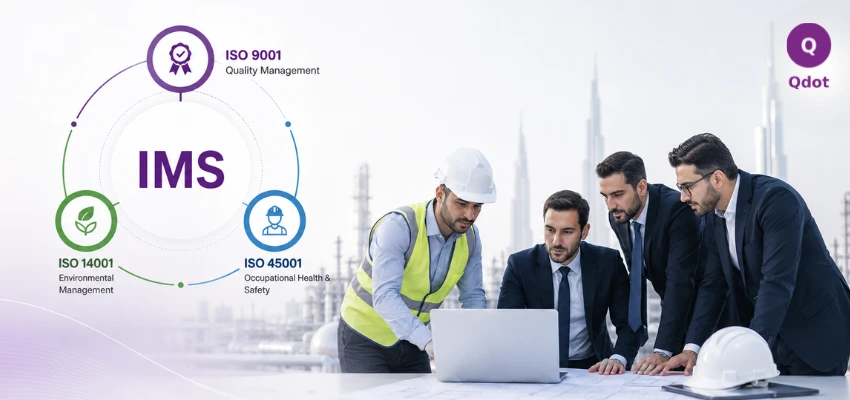
Qdot International provides Integrated Management System consultancy in the UAE, helping organizations combine ISO 9001 for quality, ISO 14001 for environmental management and ISO 45001 for occupational health and safety into one working system instead of three separate ones. Our support covers gap assessment, integrated documentation, implementation guidance, staff awareness, internal audits and management review to help prepare the system for an independent certification body's audit. Qdot is a consultancy. The certificate itself is issued by that certification body, not by us.
Talk to our IMS consultants or request a quote.
What is the difference between IMS consultancy and IMS certification in the UAE?
This is worth settling before anything else, because the two words are often used as if they mean the same service.
Consultancy is the work of building the system: interpreting the standards for your operations, designing one integrated framework, writing the documentation your teams will actually use, training people, and testing the system through internal audits. Certification is a separate, independent assessment carried out by a certification body, which decides whether your system meets the standards and issues the certificate if it does.
| Comparison | IMS consultancy (what Qdot does) | IMS certification (what a certification body does) |
|---|---|---|
| Purpose | Design, implement and improve the integrated system | Independently assess the system against the standards |
| Typical activities | Gap assessment, documentation, training, implementation support, internal audit, management review support | Stage 1 and Stage 2 certification audit, surveillance audits, recertification |
| Output | A working system with implementation evidence | A certificate, where the assessment is successful |
| Independence | Works alongside your team | Must remain independent of the organization it audits |
Accreditation provides independent confirmation of a certification body's competence, although accreditation is not compulsory. In the UAE, ENAS is the national accreditation system managed by the Ministry of Industry and Advanced Technology, while EIAC also accredits management-system certification bodies. If certificate recognition matters to your clients, verify the certification body's accreditation, approved scope and recognition before appointment.
What an Integrated Management System is
An Integrated Management System, usually shortened to IMS, is a single management framework that satisfies the requirements of two or more management system standards at the same time.
Instead of maintaining one quality manual, one environmental manual and one health and safety manual, with three sets of objectives, three internal audit programmes and three management review meetings, you operate one system. Common elements—context and interested parties, leadership and policy, risk and opportunity, roles and competence, document control, nonconformity and corrective action, internal audit, management review, continual improvement—are handled once, in one place.
Integration does not remove the specific requirements of each standard. Environmental aspects and impacts still have to be identified under ISO 14001. Hazard identification and worker consultation are still required under ISO 45001. Product and service conformity still has to be controlled under ISO 9001. What changes is the structure around those requirements, not the requirements themselves.
Integration is practical largely because ISO management system standards use the ISO Harmonized Structure, with the same clause numbering and much of the same core text. That shared structure is what allows one procedure or one register to serve several standards.
Which standards can be integrated?
A commonly used combination in the UAE is ISO 9001, ISO 14001 and ISO 45001, often described as an integrated QHSE system. It suits organizations whose clients ask about quality, environmental performance and worker safety in the same prequalification questionnaire.
| Standard | Discipline | Commonly integrated by |
|---|---|---|
| ISO 9001 | Quality management | Almost all organizations; quality is usually the base standard |
| ISO 14001 | Environmental management | Contractors, manufacturers, facilities and logistics operators |
| ISO 45001 | Occupational health and safety management | Site-based, industrial and high-hazard operations |
| ISO 22000 | Food safety management | Food manufacturing, catering and food distribution |
| ISO/IEC 27001 | Information security management | Technology, financial and data-handling services |
| ISO 22301 | Business continuity management | Organizations with critical service obligations |
There is no rule that says an IMS must contain exactly three standards. Two standards can be integrated. So can five. The right scope depends on your operations, your legal obligations and what your customers actually ask for. If you are still deciding which standards apply, our ISO consultancy team in the UAE can help you narrow the list before any documentation work begins.
Who benefits most from an integrated approach?
An IMS tends to pay off where complexity already exists. Signs that integration is worth considering:
- You already hold, or are pursuing, more than one management system certificate.
- The same manager is responsible for quality, HSE and compliance, and is duplicating effort across them.
- You operate from several sites, branches or project locations.
- Clients and main contractors ask for evidence of quality, environmental and safety controls in the same submission.
- Your teams complain that the system creates paperwork rather than control.
For a small, single-site organization implementing its first standard, a phased approach may be more practical. The initial system can still be designed for straightforward integration later. You can see the sectors we work with on our industries page.
What support do Qdot's integrated management system consultants provide?
Scope is agreed for each project. The table below sets out elements that can be included in the agreed project scope.
| Support element | What it involves | What you are left with |
|---|---|---|
| Gap assessment | A structured review of current practices, documents and records against the requirements of every standard in scope | A gap report and a prioritized action plan |
| Integration planning and scope definition | Agreeing the boundaries of the system: sites, activities, departments, exclusions and interfaces | A defined IMS scope and implementation roadmap |
| Integrated documentation | Developing one policy framework, one set of objectives, integrated procedures, registers and forms that serve all standards in scope | A documented system your teams can use, not a shelf manual |
| Risk, aspect and hazard work | Supporting the identification of quality risks, environmental aspects and impacts, OH&S hazards, and applicable legal and other requirements | Registers and controls that reflect your actual operations |
| Awareness and role-based training | Sessions for general staff, process owners and management on how the integrated system works in daily tasks. See our awareness training options | Awareness or training records |
| Internal audit support | Planning and conducting combined internal audits across the standards in scope, and supporting corrective action. Internal auditor training can be arranged separately | Audit reports and a corrective-action tracker |
| Management review support | Preparing performance data and helping top management run a single review covering all standards in scope | Support for preparing and recording an integrated management review |
| Certification readiness | A pre-audit check of implementation evidence, and support during the certification body's audit | A readiness review identifying remaining gaps before the audit |
Not every project needs every element. An organization with a mature quality system and good records may only need integration planning, documentation alignment and audit support.
How IMS implementation works
One process, followed in sequence. Timelines depend on the size of the organization, the number of standards and sites, and how much usable material already exists, so we set them during planning rather than promising them in advance.
- Diagnosis and planning. We look at what you do, where you do it, who your interested parties are, what legal and contractual obligations apply, and what controls already exist. This produces the gap report, the agreed scope and the roadmap.
- System design and documentation. Common clauses are aligned once. Standard-specific requirements are mapped so nothing is lost in the merge. Documentation is written around your processes rather than around clause numbers.
- Implementation and awareness. The system goes into use. Teams are briefed on what has changed, records start being generated, and process owners take ownership of their parts of the system.
- Internal audit and corrective action. Combined internal audits test whether the system is being applied. Findings are recorded, root causes examined, and actions tracked to closure.
- Management review and certification readiness. Top management reviews performance across all standards in scope. Remaining gaps are closed, evidence is checked, and the organization is prepared for the certification body's Stage 1 and Stage 2 audits.
Our general approach to management system projects is described on the Qdot methodology page.
Integrating a management system you already have
Many organizations are not starting from zero. They may hold ISO 9001 and want to add environmental and safety management, or they may hold several certificates that are managed as separate systems.
You do not need to dismantle a working system to integrate it. The usual route is:
- Keep what works. A functioning document control process, competence matrix or corrective action system can normally be extended to cover additional standards rather than replaced.
- Map before merging. Compare your existing procedures against the requirements of the standards being added, and identify what is already covered, what needs extending and what is genuinely missing.
- Merge the shared elements first. One policy framework, one objectives register, one audit programme, one management review. This is where most of the duplication disappears.
- Add the discipline-specific parts. Environmental aspect registers, hazard identification and worker consultation arrangements, emergency preparedness, and any legal registers required by the new standards.
- Align the certification cycle. If you hold existing certificates with different expiry dates, discuss timing with your certification body early. Bringing standards onto a common audit cycle usually needs planning ahead of a surveillance or recertification visit.
Where you already hold certificates, the transition to an integrated system also has to be handled without breaking the continuity of those certificates. That is a conversation to have with your certification body before documentation changes are rolled out.
Multi-site and multi-department operations in the UAE
Several practical points are relevant to UAE organizations.
Sites across different emirates. A head office in Dubai, a workshop in Sharjah and a project team in Abu Dhabi may face different local authority requirements and different site conditions. The system needs to be common where it can be and local where it must be.
Mainland and free zone entities. Where a group holds separate licences, decide early whether the IMS scope covers one legal entity or several, because this affects the certificate wording and how the certification body plans the audit.
How sites will be audited. Certification bodies apply their own rules, set by their accreditation requirements, for how sites are sampled in a multi-site certification. Confirm early how your locations will be treated rather than assuming every site will or will not be visited.
A multilingual workforce. Procedures and awareness material only work if people understand them. Where operational teams work in more than one language, plan for that in training material, toolbox talks, signage and forms.
Project sites with short lifecycles. For contractors, the system has to be deployable at mobilization and capable of generating records from day one, rather than assembled at the end for an audit.
Central versus local ownership. Someone has to own the system centrally, or three sites will drift into three different versions of it. Equally, site management must own local implementation, or the system stays a head office document.
What an integrated approach actually improves
Stated plainly, and without the numbers that nobody can honestly promise in advance:
- Less duplication. Shared requirements are documented, reviewed and audited once instead of two or three times.
- Clearer accountability. Process owners see one set of responsibilities rather than competing demands from separate systems.
- Better management visibility. One set of objectives and one review meeting gives leadership a single view of quality, environmental and safety performance.
- More consistent practice across sites. A single framework is easier to roll out and easier to check than several parallel ones.
- Simpler responses to client questionnaires. Prequalification and tender submissions can be answered from one set of records.
- Easier expansion. Adding a further standard later means extending an existing framework rather than starting again.
The gains come from how well the system is designed and used. A system that merges three manuals into one file without changing how work is controlled will not deliver them.
Combined internal audits and certification readiness
Where two or more management systems are audited together at the same organization, ISO 19011, the international guidance for auditing management systems, calls this a combined audit. Where those systems are genuinely integrated into one system, the same auditing principles and process apply.
In practice this means one audit programme, one audit schedule, one audit team where competence allows, and one report covering the standards in scope. The requirements of each standard are still assessed in full. A combined audit is a change in how the audit is organized, not a reduction in what has to be met.
The same logic applies to the external audit. Certification bodies can plan a combined certification audit covering several standards, and may issue either a single certificate listing the standards or separate certificates, depending on their own rules. Audit duration is calculated by the certification body according to its accreditation requirements, taking account of your scope, headcount, sites, risk profile and the degree of integration. Ask your chosen certification body how it will calculate duration for your organization rather than working from an assumed figure.
Before the certification audit, common readiness checks include whether enough time has elapsed for records to exist, whether an internal audit has covered every standard and clause in scope, whether management review includes the required inputs, and whether corrective actions have been completed rather than only logged.
Why work with Qdot?
Some straightforward facts to help you assess the fit:
- Our UAE office is in Deira, Dubai, and we support organizations across all seven emirates.
- We work across quality, environmental, occupational health and safety, food safety, information security, business continuity, social compliance and accreditation standards, which can support future integration planning.
- Awareness and internal auditor training can be delivered alongside implementation, so your own people can maintain and audit the system afterwards.
- Support is scoped to what you need. If you already have a functioning system, the scope can focus on gaps instead of unnecessarily rebuilding usable elements.
You can review our case studies and client list, or read more about how we work.
Talk to us about your integrated management system
If you are planning an IMS, adding a standard to a system you already run, or preparing for a certification audit, we can start with a gap assessment and give you a clear picture of the work involved before you commit to a scope.
Frequently Asked Questions
An Integrated Management System is a single management framework that meets the requirements of two or more management system standards at the same time, most commonly ISO 9001, ISO 14001 and ISO 45001. Shared elements such as policy, objectives, document control, internal audit and management review are handled once rather than repeated for each standard.
No. Qdot provides consultancy, implementation support and certification-readiness support. The certification audit is carried out by an independent certification body, which issues the certificate if the assessment is successful.
That depends on the certification body. Some issue a single certificate listing all the standards covered by the integrated system, others issue separate certificates for each standard. Confirm the format with your certification body before the audit, particularly if a client has asked for a specific document.
Yes. If you already hold ISO 9001, for example, the existing processes for document control, competence, corrective action and internal audit can normally be extended to cover additional standards rather than replaced. The additions are usually the discipline-specific parts, such as environmental aspect registers or hazard identification arrangements.
There is no standard answer. The main variables are the number of standards in scope, the size and complexity of the organization, the number of sites, how much usable documentation and record-keeping already exists, and how available your process owners are. A realistic timeline is set during the planning stage, once the gap assessment is complete.
Not automatically. Audit duration is calculated by the certification body under its own accreditation requirements, based on your scope, headcount, sites, risk and how genuinely integrated the system is. Ask the certification body to explain how it will calculate duration for your organization.
Start with what your operations and obligations require, and what your clients actually ask for. ISO 9001, ISO 14001 and ISO 45001 are a commonly used combination in the UAE, but there is no requirement to use exactly those three. Food, technology and service organizations may integrate ISO 22000, ISO/IEC 27001 or ISO 22301 instead of, or alongside, them.
Design the system so shared requirements are common across all locations and only genuinely local matters are handled locally. Decide early whether the scope covers one legal entity or several, and confirm with your certification body how it will sample your sites during the certification audit.