
 UAE
UAE
 Qatar
Qatar
 Pakistan
 KSA
KSA
 Oman
Oman
 Kuwait
 Bahrain
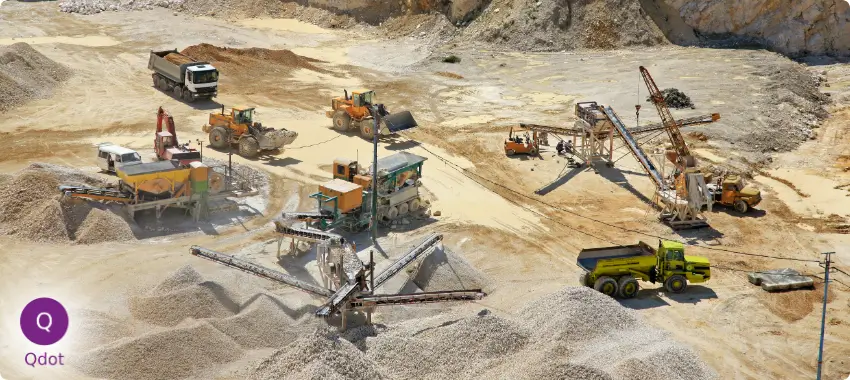
ISO certification consultancy for mining and quarrying in UAE helps quarries, aggregate producers, crushing and screening plants, and mineral-processing operations get ready for independent certification to standards such as ISO 9001, ISO 14001, and ISO 45001. Qdot International is a management-system consultancy. We help you choose the right standards, run a gap analysis, build practical controls, train your team, and prepare for the certification audit. Qdot does not issue the ISO certificate. That decision is made by an independent certification body after its own audit. This page explains which standards may apply to your operation, how they connect to real quarry risks, and how the project works.
If you already know the standards you need, you can share your details and ask for a quotation. If you are still deciding, the sections below will help you narrow the options before you commit.
Who this consultancy supports
Mining in the UAE is limited compared with large mineral-exporting countries. Quarrying and aggregate production are far more common, because construction across the Emirates needs a steady supply of crushed stone, sand, and gravel. This page is written for that reality rather than for large-scale conventional mining.
Qdot supports UAE organisations such as:
- Limestone and gabbro quarries
- Aggregate and crushed-stone producers
- Sand, gravel, and rock-extraction operations
- Fixed and mobile crushing and screening plants
- Cement raw-material suppliers
- Natural-stone and dimension-stone operations
- Mineral-processing facilities
- Drilling and blasting contractors
- Quarry transport and haulage operators
- Heavy-equipment and plant operators
- Support-service companies working on quarry and mining sites
A single-pit operator with one crushing line and a multi-site producer with several plants have very different needs. The right management system depends on your activities, your risks, your customers, and the requirements you must meet. Qdot helps you match the system to the operation instead of applying a generic template.
Operational problems ISO management systems help control
An ISO management system is a set of planned controls, records, and reviews that help you run a process consistently and improve it over time. In a quarry or plant, the value is practical: fewer surprises, clearer responsibilities, and evidence you can show to customers and auditors.
The main operational issues these systems help you manage include:
- Drilling and blasting, including charge design, exclusion zones, and blast records
- Fixed and mobile machinery, such as crushers, screens, and conveyors
- Heavy-vehicle movements and the interaction between vehicles and people on foot
- Dust and airborne particulate from extraction, crushing, and haul roads
- Noise and ground vibration affecting workers and nearby communities
- Storage of fuel, oils, and chemicals, and the risk of leaks and spills
- Water use, surface runoff, and sediment control
- Waste handling and site housekeeping
- Land disturbance, progressive rehabilitation, and biodiversity near the site
- Contractor and subcontractor control on active sites
- Maintenance and the safe isolation of energy sources during repairs
- Emergency preparedness for fire, collapse, spills, and injuries
- Product specifications, sampling, and laboratory testing of aggregates
- Aggregate quality, batch traceability, and record keeping
- Energy use across crushing, screening, conveying, pumping, and heavy plant
- Legal, permit, and customer requirements that apply to the site
No single standard covers all of these. Each ISO standard targets a specific area, and many operators combine two or three.
Which ISO standards may apply?
Four standards are the usual starting point for quarrying and aggregate operations. You do not need every one. The right selection depends on what you produce, who your customers are, and where your main risks sit.
ISO 9001 for quality and product consistency
ISO 9001 is the international standard for a quality management system. In aggregate and stone operations it helps you manage:
- Product and aggregate specifications
- Consistency across crushing, screening, and blending
- Inspection and laboratory testing of samples
- Control of suppliers and outsourced processes
- Equipment maintenance that affects product quality
- Nonconformity handling and corrective action
- Customer requirements and complaints
- Traceability and records for delivered material
An important point for producers: ISO 9001 certifies the quality management system, not an individual aggregate, stone, or mineral product. Product conformity is shown through testing against the relevant product specification, which is a separate matter from management-system certification.
ISO 14001 for environmental control
ISO 14001 is the international standard for an environmental management system. It is directly relevant to quarry impacts such as:
- Dust and airborne particulate
- Noise and vibration
- Waste generation and disposal
- Water use and surface runoff
- Fuel and chemical storage
- Spill prevention and response
- Land disturbance and progressive rehabilitation
- Biodiversity around the site
- Environmental monitoring
- Compliance obligations you have identified
ISO 14001 does not set fixed emission limits. It gives you a structured way to identify your environmental aspects, control them, monitor performance, and keep up with your compliance obligations.
ISO 45001 for occupational health and safety
ISO 45001 is the international standard for an occupational health and safety management system. Quarrying is a higher-risk activity, so this standard is often the priority. It supports control of:
- Blasting and excavation
- Crushers, screens, and conveyors
- Heavy machinery and mobile plant
- Vehicle movements and pedestrian separation
- Working at height near faces, bins, and structures
- Electrical and mechanical isolation during maintenance
- Dust and noise exposure
- Contractor safety on site
- Emergency response
- Worker consultation and participation
- Incident reporting and investigation
ISO 50001 for energy management
ISO 50001 is the international standard for an energy management system. Crushing, screening, conveying, pumping, and heavy diesel plant can make energy a large and controllable cost. ISO 50001 is most useful when energy spend is high enough to justify formal measurement, targets, and continual improvement. For a small single-line operation, energy management may be handled adequately within ISO 14001 or normal maintenance planning rather than a separate certified system.
ISO standards comparison table
The table below summarises the four core standards and their current editions as of September 2026. Confirm the applicable edition with your chosen certification body before you plan a project, because transition arrangements can affect timing.
| Standard | What it manages | Current edition (Sept 2026) | Why it matters for mining and quarrying |
|---|---|---|---|
| ISO 9001 | Quality management system | ISO 9001:2015, with Amendment 1:2024 on climate action. A revised edition (ISO 9001:2026) is expected to be published in 2026, followed by a transition period. | Consistent aggregate and stone output, laboratory testing, supplier control, traceability, and customer requirements. |
| ISO 14001 | Environmental management system | ISO 14001:2026, published 15 April 2026, replacing ISO 14001:2015. A three-year transition period applies. | Dust, noise, water and runoff, waste, spills, land disturbance, rehabilitation, and compliance obligations. |
| ISO 45001 | Occupational health and safety management system | ISO 45001:2018 | Blasting, mobile plant, crushers, vehicle and pedestrian safety, isolation, dust and noise exposure, and emergency response. |
| ISO 50001 | Energy management system | ISO 50001:2018 | Energy use across crushing, screening, conveying, pumping, and heavy plant, where spend justifies formal management. |
Standards are developed and published by the International Organization for Standardization (ISO). ISO does not certify organisations. A certified quality, environmental, or safety system means your management system met the standard at the time of the audit. It is not a permanent guarantee of product quality, safety performance, or environmental performance.
Integrated QHSE management systems
Many quarry and aggregate operators run ISO 9001, ISO 14001, and ISO 45001 together as one quality, health, safety, and environment (QHSE) system. Because these standards share a common high-level structure, several requirements can be planned and documented once, then applied across all three.
Controls that are commonly shared in an integrated system include:
- Context of the organisation and interested parties
- Risks and opportunities
- Document and record control
- Competence, training, and awareness
- Operational controls for day-to-day activities
- Internal audits
- Nonconformity and corrective action
- Management review
ISO 50001 can be added to the same framework when energy use is material enough to manage formally. Integration can reduce duplication when it is planned and implemented properly, because you maintain one set of core procedures instead of three. It does not automatically cut cost or audit time. A poorly planned integration can add confusion. The benefit comes from a clear scope, shared processes where they genuinely overlap, and standard-specific controls kept where they are needed. Qdot offers integrated management system support for operators who want a single QHSE system rather than separate ones.
Supporting standards where relevant
Two further standards are worth mentioning for some operations. Treat them as options, not part of the core four.
- ISO 55001 (asset management): May suit multi-site operators with large fleets of crushers, conveyors, and mobile plant, where structured asset planning and lifecycle decisions carry real financial weight.
- ISO 39001 (road traffic safety management): May suit haulage-heavy operations with significant on-road movements between quarries, plants, and customers.
Neither is a substitute for ISO 45001 or ISO 14001. Add them only when the specific risk or business case is clear, and confirm the current edition before starting.
Recommended systems by subsector
The table below shows standards commonly considered by different operations. It is a starting point, not a rule. Final selection depends on your processes, risks, customers, contracts, and applicable requirements.
| Operation type | Often prioritised | Sometimes added |
|---|---|---|
| Quarry and aggregate production | ISO 45001, ISO 14001, ISO 9001 | ISO 50001 |
| Crushing and screening plants | ISO 45001, ISO 9001 | ISO 14001, ISO 50001 |
| Drilling and blasting contractors | ISO 45001 | ISO 14001, ISO 9001 |
| Mineral-processing facilities | ISO 9001, ISO 45001, ISO 14001 | ISO 50001 |
| Heavy transport and haulage operations | ISO 45001 | ISO 39001, ISO 14001 |
| Multi-site integrated operators | Integrated ISO 9001, ISO 14001, ISO 45001 | ISO 50001, ISO 55001 |
A drilling and blasting contractor usually leads with safety, while a producer selling to large construction clients often needs quality certification to satisfy purchasing conditions. Two operators in the same subsector can still reach different conclusions once their contracts and site risks are considered.
How Qdot supports mining and quarrying ISO certification
Qdot works alongside your team to prepare a system that can pass an independent certification audit. Our support typically covers:
- Standard selection. Confirm which standards fit your activities, risks, customers, and goals.
- Gap analysis. Compare your current practices against the chosen standards and identify what is missing.
- Scope definition. Agree which sites, activities, and products the certification will cover.
- Documentation. Develop or improve procedures, plans, and records so they reflect how you actually work.
- Operational controls. Help you put practical controls in place for quality, environment, and safety.
- Training and awareness. Prepare employees so they understand their roles and the system in use.
- Internal audits. Conduct or support internal audits to check the system before the external audit.
- Management review. Prepare the review that top management uses to assess and steer the system.
- Gap closure. Address findings so the system is ready.
- Certification-audit readiness. Help you prepare for the independent certification body's audit.
Qdot does not issue certificates and does not make the certification decision. You appoint a separate certification body for the audit. Keeping the consultant and the certification body separate protects the credibility of the certificate, because the body auditing your system is independent of the party that helped you build it.
Documents, controls, and records the system may need
An ISO system runs on documented information, but not every document is mandatory. The exact set depends on the standards you choose, the certification scope, your sites and operations, and the requirements that apply to you. Common examples include:
- Process maps and defined responsibilities
- Quarry or operational quality plans
- Product specifications
- Sampling and laboratory-test records
- Inspection and maintenance records
- Calibration records for test and measuring equipment
- Blasting plans and blast records
- Occupational health and safety risk assessments
- An environmental-aspects register
- Dust, noise, and vibration monitoring records
- Fuel and chemical storage controls
- Contractor evaluation records
- Training and competency records
- Emergency-response arrangements
- Incident and nonconformity records
- Corrective-action records
- Internal-audit reports
- Management-review records
The goal is a system that matches how your site actually operates. Records that only exist for the auditor, and that nobody uses, add cost without adding control.
UAE regulatory, customer, and tender context
It helps to separate several requirements that are often confused. ISO certification, legal compliance, environmental permits, quarry licences, product testing, and customer approval are different things.
- ISO certification is voluntary. It is not a general legal requirement for all UAE mining and quarrying companies. Qdot does not present it as mandatory.
- Legal compliance and permits are separate. Environmental permits, quarry or mining licences, and operating approvals are set by government authorities, not by ISO. An ISO 14001 system can help you keep track of your compliance obligations, but it does not replace a permit or licence.
- Regulation varies by emirate and activity. Environmental and natural-resource oversight is shared between federal bodies, such as the Ministry of Climate Change and Environment, and emirate-level authorities. The exact rules for a specific quarry depend on its location and activity. Confirm current requirements with the relevant authority.
- Customers and tenders often ask for certification. Main contractors, government buyers, and large clients frequently require ISO 9001, ISO 14001, or ISO 45001 as a condition of supply or prequalification. This is a common commercial reason to certify.
- Accreditation affects recognition. Buyers often prefer a certificate issued by a certification body that is accredited by a recognised accreditation body, such as the Emirates International Accreditation Centre (EIAC) in the UAE. Accreditation bodies operate under the international arrangement now managed by Global Accreditation Cooperation Incorporated (Global ACI), which took over the roles of the former IAF and ILAC on 1 January 2026.
Qdot is a consultancy and is neither a certification body nor an accreditation body. If a specific legal or permit requirement matters to your decision, verify it with the responsible authority rather than relying on a general statement.
Implementation timeline and consultancy cost factors
There is no single price or fixed timeline for an ISO project, and Qdot does not quote one before understanding your operation. Both depend on scope and complexity. The main factors are:
- Number of employees
- Number of quarries, plants, and office locations
- Standards selected
- Operational complexity
- The state of your existing documentation
- Level of contractor involvement
- Environmental and safety risk profile
- Number of shifts
- Certification scope
- Whether you run an integrated or separate systems
- Staff availability during the project
- Customer or tender deadlines
- The certification body's audit requirements
One cost point is worth making clearly: Qdot's consultancy fee and the certification body's audit fee are separate. You pay Qdot for implementation support and pay your chosen certification body for the audit and certificate. Budgeting for both from the start avoids surprises later.
Practical implementation guidance
A few habits tend to make quarry and aggregate projects go more smoothly:
- Start with a gap analysis. Knowing where you stand prevents wasted effort on things you already do well.
- Define a realistic scope. Include the sites and activities you can genuinely control and maintain.
- Build the system around real work. Base procedures on how your crews already operate, then improve from there.
- Bring contractors in early. On active sites, contractor control is often where audits find the most gaps.
- Keep records usable. Simple, consistent records beat large documents that nobody maintains.
- Integrate where it genuinely helps. Combine shared processes across quality, environment, and safety, but keep standard-specific controls distinct.
- Run a real internal audit. Treat it as a genuine check before the external audit, not a formality.
These steps improve readiness. They do not guarantee a certification outcome, which always rests with the independent certification body.
Plan your mining or quarrying ISO project with Qdot
If you want to move forward, the fastest way to get a useful response is to share the details of your operation. Please tell us:
- Your activities and products
- Your quarry, plant, and office locations
- Your employee numbers
- Your number of shifts
- Any existing certifications
- The standards you think you need
- Any customer or tender requirements
- Your target audit date
- Your current documentation status
With that information, Qdot can advise on the standards that fit and outline a realistic path to certification readiness.
FAQs
For most quarries, ISO 45001 for occupational health and safety is the priority, because blasting, mobile plant, crushers, and vehicle movements create significant risk. Many quarries then add ISO 14001 for environmental control and ISO 9001 for aggregate quality. The right mix depends on your risks, products, and customer requirements.
No. ISO certification is voluntary and is not a general legal requirement for all UAE mining and quarrying companies. It is often required by customers, main contractors, or tenders as a condition of supply. Legal compliance, permits, and quarry licences are separate requirements set by government authorities, and they can differ by emirate and activity.
ISO 45001 gives you a structured way to control the hazards that make quarrying high-risk, including blasting, heavy machinery, crushers and conveyors, vehicle and pedestrian movements, isolation during maintenance, and dust and noise exposure. It also requires worker consultation, emergency planning, and incident investigation, so problems are identified and acted on rather than repeated.
ISO 14001 helps you manage the environmental aspects of extraction and processing, such as dust, noise and vibration, waste, water use and runoff, fuel and chemical storage, spills, land disturbance, and rehabilitation. It requires you to identify these aspects, control them, monitor performance, and track your compliance obligations. It does not set fixed emission limits or replace an environmental permit.
No. ISO 9001 certifies the quality management system, not an individual aggregate, stone, or mineral product. It helps you produce consistent material and keep proper records. Product conformity is shown separately by testing against the relevant product specification, which is not the same as management-system certification.
Yes. Because these standards share a common structure, they can be combined into one QHSE management system with shared controls for context, risk, document control, competence, internal audits, corrective action, and management review. Integration can reduce duplication when it is planned well. It does not automatically reduce cost or audit time.
There is no fixed timeline or price. Both depend on the number of employees and sites, the standards chosen, operational complexity, existing documentation, risk profile, shifts, certification scope, and staff availability. Qdot's consultancy fee and the certification body's audit fee are separate, so budget for both.
No. Qdot is a management-system consultancy. We help you select standards, close gaps, build controls, train staff, and prepare for the certification audit. The audit and the certification decision are made by an independent certification body, which keeps the certificate credible.