
 UAE
UAE
 Qatar
Qatar
 Pakistan
 KSA
KSA
 Oman
Oman
 Kuwait
 Bahrain
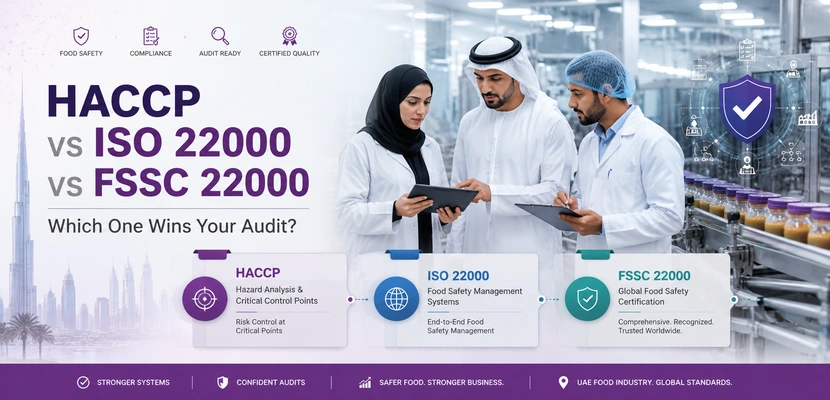
A decision guide for UAE food manufacturers in 2026
If you run a food manufacturing business in the UAE, you have almost certainly been asked at least one of these questions in the last twelve months:
- “Are you HACCP certified?” — from Dubai Municipality or ADAFSA
- “Do you hold ISO 22000?” — from a hotel group, airline caterer or institutional buyer
- “Are you GFSI recognised? FSSC 22000?” — from a European retailer, a UK importer, or a multinational FMCG brand looking for a co-manufacturer
Three different certifications. Three different conversations. And one question every operations manager eventually asks us at Qdot: which one do I actually need?
The short answer is that they are not competitors. They are layers. HACCP is the foundation, ISO 22000 is the management system built on top of it, and FSSC 22000 is the GFSI-recognised scheme built on top of that. The right question is not “which is best” but “which layer matches the buyers I am selling to and the markets I want to enter.”
This guide walks you through that decision the way we walk our clients through it — with a clear decision tree at the end.
The Three Standards in One Paragraph Each
HACCP — the foundation
HACCP (Hazard Analysis and Critical Control Points) is a methodology, not a management system. It is built on seven internationally recognised principles: hazard analysis, identification of critical control points, establishment of critical limits, monitoring procedures, corrective actions, verification, and record-keeping. Every modern food safety standard in the world — including ISO 22000 and FSSC 22000 — has HACCP at its core.
In the UAE, HACCP-based food safety systems are the regulatory baseline. Dubai Municipality's Food Safety Department requires all food establishments to operate HACCP-based systems, and ADAFSA enforces equivalent requirements across Abu Dhabi. UAE Cabinet Decision No. 21 of 2020 on Food Safety reinforces this at the federal level. If you manufacture food in the UAE and you cannot produce HACCP evidence on inspection day, you have a regulatory problem before you have a commercial one.
ISO 22000 — the management system
ISO 22000:2018 takes the seven HACCP principles and wraps them inside a full ISO management system structure — the same Annex SL High Level Structure that ISO 9001, ISO 14001 and ISO 45001 use. That means context of the organisation, leadership, planning, support, operation, performance evaluation and continual improvement, all applied to food safety.
In practical terms, ISO 22000 adds three things HACCP alone does not give you: a management framework that integrates cleanly with your other ISO systems, prerequisite programme (PRP) requirements that formalise hygiene and infrastructure controls, and an internationally recognised certificate that travels well outside the UAE. It is the standard most demanding hotel groups, airline caterers and institutional clients ask for by name.
FSSC 22000 — the GFSI-recognised scheme
FSSC 22000 is not an ISO standard. It is a certification scheme built on three components: ISO 22000, a sector-specific prerequisite programme (the ISO/TS 22002 series), and a set of additional FSSC requirements covering food defence, food fraud, environmental monitoring, allergen management and — since Version 6 — food loss and waste.
The critical point for UAE manufacturers is that FSSC 22000 is recognised by the Global Food Safety Initiative (GFSI). When a European retailer, a multinational FMCG brand, or a major international foodservice buyer says they only work with “GFSI-recognised” suppliers, FSSC 22000 is one of the certifications that opens that door. BRCGS and SQF are the others.
FSSC 22000 Version 6 has been the current audit standard since April 2024. Foundation FSSC published Version 7 in May 2026, and a 12-month transition period applies — so if you are pursuing FSSC 22000 in 2026, you need to be planning around V7, not V6.
What Each One Actually Costs You — in Time and Structure
This is where the conversation gets practical. The certifications differ not only in scope but in implementation effort.
HACCP can typically be implemented in three to six months for a small or mid-sized food manufacturer. You need a HACCP team, hazard analysis documentation, CCP monitoring records, verification procedures, and trained personnel. The audit is focused and specific.
ISO 22000 typically requires six to nine months. You are now building a management system: documented policy, objectives, internal audits, management reviews, competence records, and integration with other functions of the business. If you already hold ISO 9001, much of the structural work is reusable.
FSSC 22000 typically requires nine to twelve months for a first-time implementation, sometimes longer. You are layering sector-specific PRPs (ISO/TS 22002-1 for food manufacturers is the most common), food defence and food fraud assessments, allergen and environmental monitoring programmes, and the V6 (transitioning to V7) additional requirements on top of a full ISO 22000 system. The audit is the most rigorous of the three.
The cost progression follows the same curve. We tell clients to budget realistically for the layer above the one they are tempted to “stop at” — because in our experience, almost every food manufacturer that stops at HACCP comes back within eighteen months asking for ISO 22000, and a meaningful share of those return again for FSSC 22000 once a major buyer demands it.
The Decision Tree
Here is how we help UAE food manufacturers decide:
Pick HACCP if:
- You sell exclusively into the UAE domestic market
- Your customers are local restaurants, retailers or distributors who do not require ISO-level certification
- You need to satisfy Dubai Municipality, ADAFSA or Sharjah Municipality requirements and demonstrate basic food safety competence
- You are an SME building your food safety system for the first time and need a solid foundation before expanding
Pick ISO 22000 if:
- You supply hotels, airlines, hospitals, schools, or large institutional caterers in the UAE or GCC
- You export to markets that recognise ISO certification but do not specifically mandate GFSI schemes — much of the Middle East, parts of Africa, and several Asian markets
- You already hold ISO 9001 and want an integrated management system rather than a parallel food safety programme
- You want international recognition without the cost and complexity of a GFSI scheme
- Your buyers ask for “ISO certification” generically and you need a credible answer
Pick FSSC 22000 if:
- You export to European retailers, UK supermarkets, or any market where GFSI recognition is a procurement requirement
- You manufacture private-label or co-packed products for multinational FMCG brands
- You supply major international hotel chains or airline groups that require GFSI-recognised certification
- You are bidding for contracts where the tender explicitly names GFSI, BRCGS or FSSC 22000
- You are positioning your facility for acquisition, investment, or significant international growth
Pick a combination if: you are in transition. Many of our clients hold HACCP for daily regulatory compliance demonstration, ISO 22000 as their core management system, and then move to FSSC 22000 when a specific buyer requires it. These are not mutually exclusive — they stack.
The Audit Perspective: Which One Is Hardest to Pass?
Since you asked the question as “which one wins your audit,” it is worth being direct.
The HACCP audit is the most forgiving — but also the easiest to fail on documentation gaps, because clients sometimes underestimate it. The most common failures we see are weak hazard analyses, CCPs that are identified but not properly monitored, and verification records that exist on paper but cannot be tied to actual production runs.
The ISO 22000 audit is harder because the auditor is now evaluating a management system, not just a hazard plan. Failures cluster around weak management reviews, poorly conducted internal audits, and food safety objectives that are not measurable.
The FSSC 22000 audit is the most rigorous of the three. V6 audits, in our experience, fail most often on environmental monitoring programme weaknesses, food fraud vulnerability assessments that are not genuinely operational, allergen management gaps, and — increasingly — food loss and waste documentation. V7 will tighten several of these areas further.
The honest answer is that the certification that “wins your audit” is the one you have implemented genuinely rather than cosmetically. We have seen FSSC 22000 sail through and HACCP fail in the same week, simply because the FSSC client treated the system as operational and the HACCP client treated it as paperwork.
Where to Start
If you are a UAE food manufacturer reading this and you are not certified to any of them yet, start with HACCP. Get the foundation right. If your business plan includes institutional clients, exports, or growth beyond the UAE domestic market, plan ISO 22000 as the next layer within twelve to eighteen months. If your buyers are pulling you toward European retail or multinational private label, FSSC 22000 is where you will end up — and starting that planning early is far cheaper than scrambling when a buyer requires it.
Related reading: Common Reason HACCP Audit Failures in UAE
At Qdot, we work with food manufacturers across the UAE, KSA, Qatar and the wider GCC on all three of these certifications — and on the integrated systems that combine them with ISO 9001, ISO 14001 and ISO 45001. If you would like a no-obligation gap assessment against any of these standards, or a roadmap that matches your buyer pipeline.
FAQ's
They are not direct competitors. HACCP is the food safety foundation, ISO 22000 is the management system layer, and FSSC 22000 is the GFSI-recognised scheme used when international buyers require stronger assurance.
HACCP is suitable when a company sells mainly in the UAE domestic market and needs to demonstrate basic food safety controls for local regulatory and customer requirements. Companies targeting hotels, institutional buyers or exports usually need ISO 22000 or FSSC 22000.
ISO 22000 is a good choice for companies supplying hotels, airlines, hospitals, schools, large caterers, GCC buyers or export markets that recognise ISO certification but do not specifically demand a GFSI-recognised scheme.
FSSC 22000 is needed when a buyer, retailer, tender or multinational brand requires GFSI-recognised certification. It is especially relevant for European retail, UK supermarkets, private-label manufacturing and multinational FMCG supply chains.
No. FSSC 22000 is a certification scheme built on ISO 22000, sector-specific prerequisite programme requirements and additional FSSC requirements such as food defence, food fraud, allergen management and environmental monitoring.
For a small or mid-sized food manufacturer, HACCP can typically take three to six months, ISO 22000 usually takes six to nine months, and FSSC 22000 often takes nine to twelve months for a first-time implementation.
Yes. Many food manufacturers use HACCP for regulatory food safety evidence, ISO 22000 as the core food safety management system, and FSSC 22000 when specific buyers require GFSI-recognised certification.