
 UAE
UAE
 Qatar
Qatar
 Pakistan
 KSA
KSA
 Oman
Oman
 Kuwait
 Bahrain
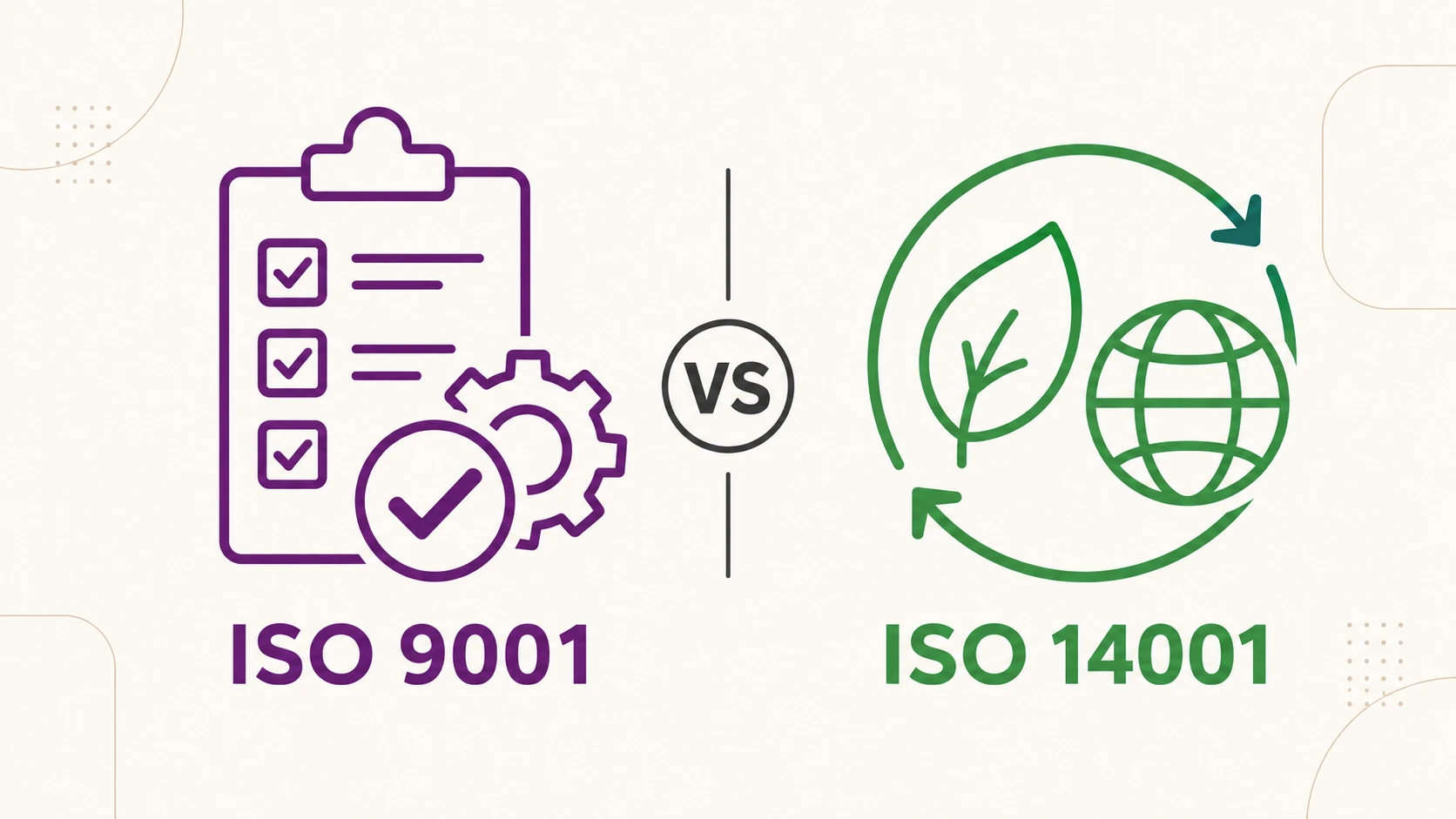
If you have to choose one, most UAE businesses start with ISO 9001 because it covers quality management and is the certification most often requested in local tenders and by clients. Choose ISO 14001 first when your environmental footprint is central to your work or your contracts, such as construction, manufacturing, logistics, or energy. The two standards solve different problems: ISO 9001 improves the quality and consistency of what you deliver, while ISO 14001 helps you manage and reduce your environmental impact. Many UAE companies eventually hold both. This guide explains the real differences, what changed in the 2026 editions, and how to decide.
What UAE businesses need to know first
- ISO 9001 is the international standard for a Quality Management System (QMS). ISO 14001 is the standard for an Environmental Management System (EMS).
- In the UAE, ISO 9001 is the most commonly requested certification for tenders and supplier qualification. ISO 14001 is frequently required for construction, oil and gas, facilities management, and other environmentally sensitive work.
- The two standards share the same underlying framework (the Harmonised Structure), so they are designed to be implemented together as an Integrated Management System.
- ISO 9001:2026 was published on 16 September 2026 and replaces ISO 9001:2015. ISO 14001:2026 was published on 15 April 2026 and replaces ISO 14001:2015. Organisations already certified to the previous editions can transition according to the applicable transition arrangements.
- ISO does not certify companies. An independent, accredited certification body performs the audit. A consultancy such as Qdot International helps you prepare.
ISO 9001 vs ISO 14001 at a glance
The table below summarises the core differences before we look at each standard in detail.
| Point of comparison | ISO 9001 (Quality) | ISO 14001 (Environment) |
|---|---|---|
| Full name | Quality management systems | Environmental management systems |
| System type | Quality Management System (QMS) | Environmental Management System (EMS) |
| Main purpose | Consistent products and services, customer satisfaction | Manage and improve environmental performance |
| Central question | Are we doing things well and consistently? | Are we controlling our impact on the environment? |
| Typical drivers | Customer requirements, tenders, efficiency | Regulations, sustainability goals, client demands |
| Best suited to | Any organisation, product or service | Sectors with a significant environmental footprint |
| Current edition | ISO 9001:2026 | ISO 14001:2026 |
| Shared foundation | Harmonised Structure, risk-based thinking, continual improvement | Harmonised Structure, risk-based thinking, continual improvement |
The most important takeaway is that these are not competing standards. They answer different questions, and a business can be certified to one, the other, or both.
What is ISO 9001?
ISO 9001 is the international standard for a Quality Management System. It sets out how an organisation should plan, control, and improve its processes so that it consistently meets customer and regulatory requirements.
The standard is built on seven quality management principles: customer focus, leadership, engagement of people, a process approach, improvement, evidence-based decision making, and relationship management. In practice, certification means you have documented how work gets done, you monitor whether it is working, and you correct problems in a structured way.
ISO 9001 was first published in 1987 and is the most widely used management system standard in the world. According to the ISO Survey 2024, more than 1.4 million ISO 9001 certificates were valid worldwide at the end of 2024. Because it applies to any sector, it is usually the first certification a UAE company pursues.
What is ISO 14001?
ISO 14001 is the international standard for an Environmental Management System. It gives organisations a framework to identify their environmental aspects (the ways their activities affect the environment), set objectives, control risks, meet legal obligations, and improve performance over time.
Where ISO 9001 focuses on the customer, ISO 14001 focuses on the environment and on the organisation's legal and stakeholder obligations. It covers areas such as energy and water use, waste, emissions, pollution prevention, and the life cycle of products and services.
ISO 14001 was first published in 1996. It remains the most widely used environmental management standard, with around 676,000 certificates valid worldwide at the end of 2024, according to the ISO Survey 2024. In the UAE, interest has grown alongside stricter environmental rules and rising client expectations around sustainability.
The main differences between ISO 9001 and ISO 14001
The clearest way to separate the two is by what each one is designed to protect.
- Focus. ISO 9001 protects quality and customer satisfaction. ISO 14001 protects environmental performance and compliance.
- Core inputs. ISO 9001 works from customer requirements and process performance. ISO 14001 works from environmental aspects, legal requirements, and environmental risks.
- Who usually asks for it. Clients and tender committees commonly ask for ISO 9001 as proof of reliable delivery. Environmental regulators, developers, and sustainability-focused buyers are more likely to require ISO 14001.
- Typical evidence. ISO 9001 audits look at process controls, records, corrective action, and customer feedback. ISO 14001 audits look at your environmental register, compliance obligations, monitoring, and emergency preparedness.
What ISO 9001 and ISO 14001 share
Both standards are built on the same Harmonised Structure (previously called Annex SL), the common framework that ISO uses for its management system standards. This is why the two feel similar once you look inside them.
Shared requirements include understanding the context of the organisation, leadership commitment, risk-based thinking, planning, competence and awareness, documented information, internal audits, management review, and continual improvement. Because the backbone is the same, a business that already runs ISO 9001 will recognise most of the structure when it adds ISO 14001. A certification body can also carry out a combined audit, which reduces duplication.
Which ISO standard does your UAE business actually need?
Start with the reason you are certifying. If a specific contract or tender names a standard, that decision is already made for you. If you are choosing proactively, use the guidance below.
Choose ISO 9001 first if
Your priority is winning work, improving consistency, or reducing errors and rework. ISO 9001 suits professional services, trading companies, IT providers, and any business where clients care most about reliable delivery. It is also the most common baseline requirement across UAE government and semi-government supplier registrations, so it usually gives the widest commercial return as a first step. Learn more about ISO 9001 consultancy in the UAE.
Prioritise ISO 14001 if
Your environmental impact is significant or your clients specifically ask for it. This is common in construction, civil works, manufacturing, oil and gas, waste and facilities management, and logistics. If you are bidding for contracts with environmental conditions, or working with buyers that assess supplier sustainability, ISO 14001 may matter more than a quality certificate. Learn more about ISO 14001 environmental consultancy in the UAE.
Consider both as an Integrated Management System if
You expect to need both within a year or two, or you operate in a sector where quality and environmental performance are assessed together. Because the two standards share a structure, implementing them as one Integrated Management System (IMS) is usually more efficient than doing them separately. Many UAE construction and industrial firms combine ISO 9001, ISO 14001, and ISO 45001 (occupational health and safety) into a single QHSE system to meet tender requirements in one project.
For a wider comparison that includes ISO 45001 and other standards, read Qdot's guide to choosing the right ISO standard in the UAE.
What UAE tenders and clients actually ask for
In the UAE, ISO certification is rarely a legal requirement in itself, but it often works as a “ticket to trade”. Many public sector, semi-government, and large private buyers list relevant ISO certifications as prequalification criteria. A supplier without the required certificates can be excluded before the technical or commercial proposal is even reviewed.
General patterns reported across the market include:
- ISO 9001 as a baseline quality requirement for a wide range of supplier categories.
- ISO 14001 and ISO 45001 commonly requested for construction, engineering, infrastructure, and facilities contracts, especially those with environmental or site-safety impact.
- Sector-specific combinations, for example additional standards such as ISO/IEC 27001 for technology suppliers handling sensitive data.
Tender rules differ by entity, sector, and contract value, and they change over time. Always confirm the exact certification required in the specific tender document or supplier portal before you commit to a certification programme.
The 2026 editions: what changed and should you wait?
Both standards now have 2026 editions, and UAE businesses should consider the current editions and applicable transition arrangements when planning certification.
ISO 14001:2026 was published by the International Organization for Standardization on 15 April 2026. It is the fourth edition and replaces ISO 14001:2015. ISO and certification bodies describe the update as a refinement rather than a rewrite. It incorporates the 2024 climate change amendment, adds environmental conditions such as resource use, pollution, and biodiversity to the analysis of context, clarifies the life cycle perspective, and improves guidance. Organisations certified to the 2015 edition have until 30 April 2029 to move to the new edition to keep their certificates valid.
ISO 9001:2026 was published on 16 September 2026 and replaces ISO 9001:2015 as the current edition. The revision is a targeted evolution rather than a complete rebuild. It strengthens emphasis on leadership, quality culture and accountability, gives clearer treatment of risks and opportunities, and improves alignment with other ISO management system standards. From 31 March 2028, new and initial accredited certifications may only be issued to ISO 9001:2026. Organisations already certified to ISO 9001:2015 have until 30 September 2029 to complete their transition.
Should you wait? For new ISO 9001 projects, organisations should now plan around ISO 9001:2026 and confirm with their chosen certification body which edition it can currently certify against during the transition period. Existing ISO 9001:2015-certified organisations do not need to restart certification; they have until 30 September 2029 to transition. For ISO 14001, organisations should work with their certification body on transition to ISO 14001:2026. For more detail, read Qdot's ISO 9001:2026 transition guide.
How certification works in the UAE, and who does what
A common point of confusion is who actually issues the certificate. Understanding the roles saves time and money.
- ISO develops and publishes the standards. It does not audit or certify individual companies.
- A certification body (an independent third party) audits your management system and decides whether to issue the certificate. Where possible, choose a body accredited by a recognised accreditation body, because accredited certificates carry more weight in tenders.
- An accreditation body assesses whether a certification body is competent. In the UAE, accreditation is often held through recognised international or regional accreditation bodies.
- A consultancy such as Qdot International helps you get ready. This can include a gap assessment, building documentation, implementing the system, staff training, and internal audit preparation. The consultancy does not issue the certificate.
A typical certification journey looks like this:
- Gap assessment. Compare current practice against the standard.
- Implementation. Build or update processes, documentation, and records.
- Internal audit and management review. Check the system works before the external audit.
- Certification audit. The certification body reviews your system in two stages.
- Certification and surveillance. After a successful audit, the certificate is typically valid for three years, with regular surveillance audits.
Cost and timelines depend on your size, number of sites, complexity, and how mature your processes already are. Be cautious of any provider promising a certificate in a few days without a genuine audit, as certificates without proper accredited assessment can be rejected by tender committees.
Common mistakes UAE businesses make when choosing
A few avoidable errors come up repeatedly.
- Choosing the wrong standard for the contract. Read the tender first. A quality certificate will not satisfy a requirement for an environmental one.
- Treating certification as paperwork. A system that only exists on paper tends to fail at the surveillance audit and delivers little real benefit.
- Ignoring the 2026 editions. Both ISO 9001:2026 and ISO 14001:2026 are now published, so new projects should consider the current editions and existing certified organisations should understand their transition requirements.
- Assuming any certificate is accepted. Non-accredited or “instant” certificates may not be recognised by government buyers.
- Doing standards separately when both are needed. If you know you need quality and environmental certification, an integrated approach is usually more efficient.
Getting certification-ready with Qdot International
The right choice comes down to why you are certifying and what your clients require. If quality and winning work are the priority, ISO 9001 is usually the sensible first step. If your environmental impact or your contracts demand it, ISO 14001 should come first. If you need both, an integrated system is often the most efficient path.
Qdot International is a UAE-based business management consultancy that helps organisations prepare for ISO certification, from an initial gap assessment through documentation, implementation, and internal audit readiness. To discuss which standard fits your business and your target tenders, contact the Qdot team for an initial consultation.
FAQs
Neither is better overall, because they solve different problems. ISO 9001 improves quality and is the certification most commonly requested in UAE tenders, so it is usually the better first step. ISO 14001 is better when your environmental impact or your clients make environmental management the priority.
Yes. Both standards share the same Harmonised Structure, so they can be implemented together as an Integrated Management System and assessed in a combined audit. This is often more efficient than certifying to each standard separately.
ISO certification is generally not a legal requirement, but it is frequently listed as a prequalification condition in government, semi-government, and large private tenders. In practice, many UAE businesses need it to be eligible to bid, so it functions as a commercial requirement.
No. ISO writes and publishes the standards but does not certify organisations. An independent certification body audits your system and issues the certificate. A consultancy can help you prepare, but it does not issue the certificate either.
ISO 14001:2026 was published on 15 April 2026 and replaces the 2015 edition. The changes are described as a refinement rather than a rewrite. They include the 2024 climate change amendment, wider environmental conditions such as resource use and biodiversity in the analysis of context, clearer guidance on the life cycle perspective, and improved guidance. Organisations certified to ISO 14001:2015 have until 30 April 2029 to transition.
ISO 9001:2026 is now the current edition. Organisations already certified to ISO 9001:2015 have until 30 September 2029 to transition. New and initial accredited certifications move exclusively to ISO 9001:2026 from 31 March 2028. Existing organisations should plan the transition with their certification body rather than restarting certification.
Construction companies in the UAE are commonly asked for ISO 9001 (quality), ISO 14001 (environment), and ISO 45001 (occupational health and safety), often together as a QHSE integrated system, because tenders frequently require all three. Always check the specific tender for the exact standards named.