
 UAE
UAE
 Qatar
Qatar
 Pakistan
 KSA
KSA
 Oman
Oman
 Kuwait
 Bahrain
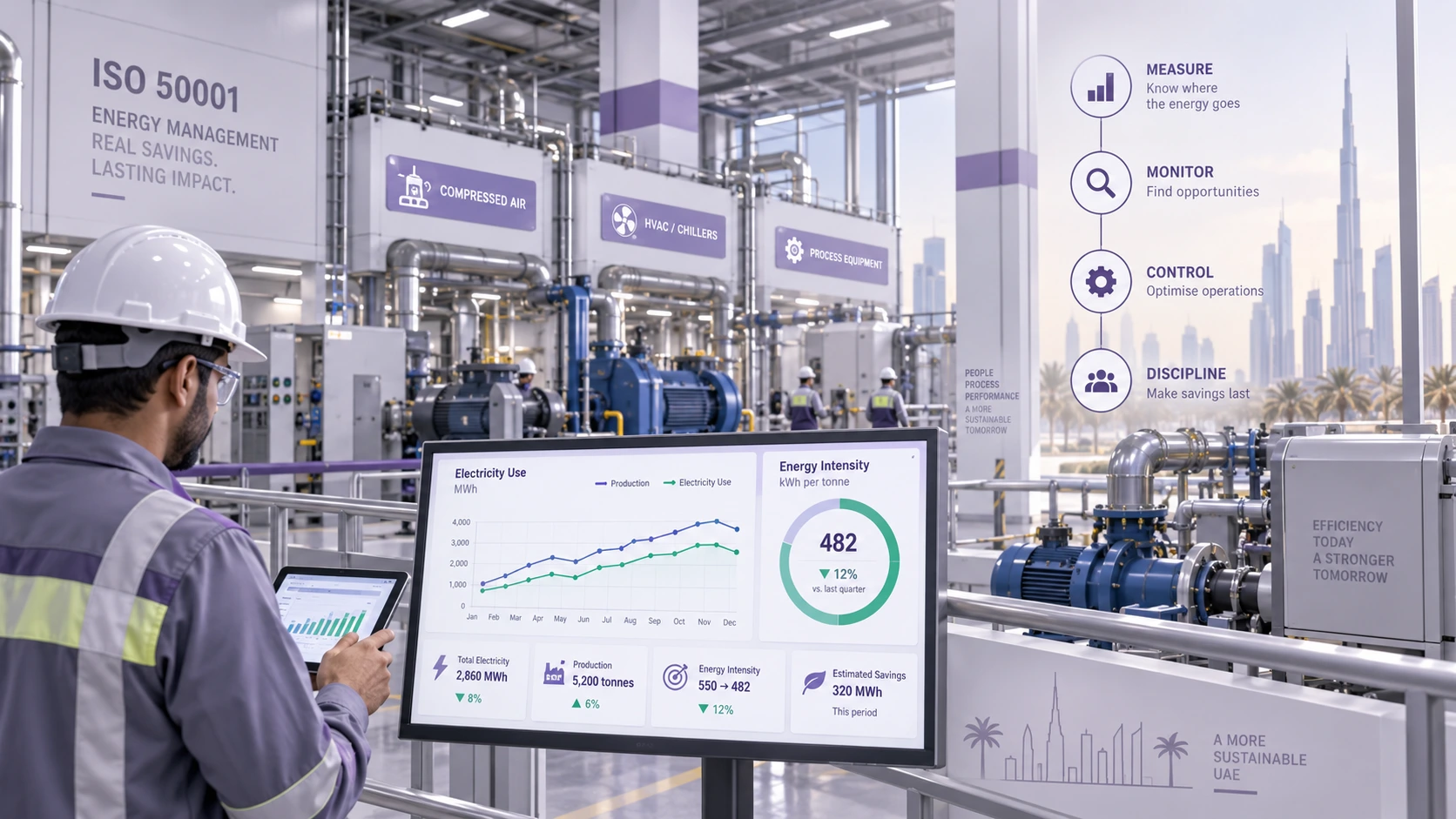
ISO 50001 energy management works in a UAE factory when four things happen: the plant identifies the handful of systems that consume most of its energy, measures them against a baseline that accounts for production and weather, changes how those systems are operated day to day, and writes efficiency into future purchase and design decisions. The certificate itself saves nothing. The savings come from the operating discipline the standard forces onto energy, in the same way a quality system forces discipline onto defects.
Why an energy certificate does not reduce a single kilowatt-hour
ISO 50001:2018 is the international standard for an energy management system (EnMS), a structured way of managing energy performance using the Plan-Do-Check-Act cycle. It was reviewed and confirmed by ISO in 2024, and ISO 50001:2018/Amd 1:2024 adds climate action considerations without creating a new edition.
Many UAE plants already run energy projects. They replace lighting, fit variable speed drives, service the chiller plant. What those projects often lack is a system that decides which project matters most, proves whether it worked, and stops the saving from quietly disappearing eighteen months later when a setpoint gets changed during a hot week and never changed back.
That persistence is the measurable difference. A 2023 study published in Sustainable Energy Technologies and Assessments by researchers at Lawrence Berkeley National Laboratory analysed verified energy performance data from 83 manufacturing facilities that implemented ISO 50001. It reported average annual energy performance improvement of around 4.1 per cent in the first year of implementation, with facilities still averaging around 3.4 per cent twelve years later (Fitzgerald et al., 2023). Those were facilities outside the UAE, so treat the figures as evidence that the mechanism works rather than as a forecast for your site. Your result depends on how much waste exists before you start.
Start with significant energy uses, not a list of good ideas
The energy review is where the opportunities are identified. It asks the plant to analyse where energy actually goes, then designate its significant energy uses (SEUs): the systems, processes or equipment that account for substantial consumption or offer considerable improvement potential. Action plans, operational controls and competence are what convert those opportunities into savings later.
This matters because energy consumption is rarely spread evenly. In manufacturing generally, a small number of systems account for most of the bill, which is why the standard asks you to identify them explicitly rather than work through a list of ideas.
The energy review also requires you to identify the relevant variables that affect each SEU. These are site and process specific. Depending on the operation they can include production volume, product mix, batch size, raw material moisture or composition, shift pattern, operating hours, occupancy, humidity and ambient temperature. Ambient temperature deserves particular attention in the UAE, because the gap between a January night and an August afternoon changes cooling load substantially, and any comparison that ignores it will mislead you.
| Common significant energy use | What usually drives the waste | First thing to measure |
|---|---|---|
| Chiller plant and HVAC | Setpoints held at summer settings year round, poor staging, low delta-T across coils | kW per ton of refrigeration (kW/TR) at part load, chilled water supply and return temperatures |
| Compressed air | Leaks, system pressure set higher than any application needs, open blowing for cleaning or drying | Specific power in kW per m³/min of delivered air, leak-down test during a planned shutdown, pressure at point of use |
| Process heat: ovens, furnaces, boilers, dryers | Idling between batches, missing or damaged insulation, excess combustion air | Fuel per tonne of output, flue gas oxygen, surface temperatures |
| Motors, pumps and fans | Flow throttled by valves or dampers, motors running lightly loaded, no shutdown routine | Motor loading, run hours compared with production hours |
| Refrigeration and cold storage | Door discipline, defrost cycles running longer than needed, fouled condensers | kWh per tonne stored per day, suction and discharge pressures |
| Lighting | Full illumination in unoccupied areas and during daylight hours | Installed power density in W per m², run hours by zone |
The pattern in that table is worth noticing. Almost every entry is an operating problem rather than an equipment problem, which is why the early savings are usually cheap.
Baselines and EnPIs: why raw kWh comparisons mislead in the UAE
An energy baseline is the reference period your performance is measured against. An energy performance indicator (EnPI) is the measure you track, such as kWh per tonne produced or kW per ton of refrigeration.
The requirement that produces real insight is normalisation. If production, weather or operating hours materially affect consumption, the method of adjusting for them has to be documented. Without it, a plant can cut genuine waste and still show a higher bill, or coast through a slow quarter and congratulate itself.
Here is an illustrative comparison of the kind that surfaces in a first energy review:
| Month | Production (tonnes) | Electricity (MWh) | kWh per tonne |
|---|---|---|---|
| March | 4,000 | 2,000 | 500 |
| July | 5,200 | 2,860 | 550 |
Raw consumption rose by 43 per cent, which looks alarming on a monthly report. Energy intensity rose by 10 per cent, which is the number worth investigating, and part of that 10 per cent is likely explained by summer cooling load rather than by anything the production team did. Once ambient temperature is built into the model, what remains is the part you can actually manage. These figures are illustrative, used to show the method rather than to represent any particular site.
This is also where metering arrangements matter. A single utility meter tells you the plant used more energy. A meter on the chiller plant, the compressor house and the main process line tells you which one, and when. ISO 50001 does not prescribe a metering arrangement, and measurement can be continuous, periodic, portable or calculated from operating parameters. What the standard does require is that the method is documented and produces results accurate enough to support the decisions you make from them. Whether permanent submetering is worth installing on a given system depends on its share of consumption, the cost of the meter and what the data is expected to reveal.
The opportunities that usually surface first
Across manufacturing generally, the opportunities an energy review turns up early tend to cost little and depend on behaviour, settings and maintenance rather than capital. They commonly include:
- Compressed air leaks. Leak-down testing during a planned shutdown, then repair, then a check that the saving held. Many plants also find system pressure is set well above what any application requires.
- Idle and out-of-hours running. Ovens, compressors, extraction fans and conveyors left running between shifts or batches because no one owns the shutdown sequence.
- Chiller and AHU setpoints. Settings adjusted during a hot spell and never returned, or plant staged to run several machines at low load when fewer at higher load would be more efficient.
- Condenser and coil cleaning. In a dusty environment, fouling degrades performance steadily and invisibly until someone measures approach temperature.
- Throttled flow. Pumps and fans controlled by valves or dampers rather than speed, which burns energy to create resistance.
None of these are exotic. The reason they persist is that nobody's job description includes finding them, and no report would show them if they did. ISO 50001 fixes that by assigning ownership, setting objectives with action plans, and requiring a monitoring and measurement plan that would expose the drift.
Where the capital projects fit
Capital measures such as variable speed drives, heat recovery, chiller replacement or solar generation belong in an ISO 50001 programme, but they belong after the energy review rather than before it. Two reasons.
First, sizing. Equipment specified against current demand locks in the waste. Fixing the leaks and setpoints first means the replacement compressor or chiller is sized for what the plant actually needs.
Second, evidence. A certification body will look for a link between your objectives, your action plans and your measured performance. A capital project chosen because a vendor was persuasive is harder to defend at audit than one chosen because the energy review identified it as the largest controllable use.
Locking savings in through procurement and design
The clauses UAE plants tend to underuse are the ones on procurement and design. ISO 50001 asks you to set energy performance criteria when purchasing energy-using equipment and energy services, and to consider energy performance improvement opportunities when designing new, modified or renovated facilities, equipment, systems and energy-using processes that can have a significant impact on energy performance.
In practice this means a purchase specification that states efficiency requirements and part-load performance rather than just capacity and price, and a design review on new lines that asks about metering, heat recovery and control before the layout is frozen. Equipment bought this year will be running in 2040. Decisions made at purchase outlast almost every operational improvement you will make.
Making the savings survive the second year
Year one savings are the easy part. Persistence is what separates an EnMS from an efficiency campaign.
The mechanisms the standard provides for this are unglamorous and effective:
- A monitoring and measurement plan that specifies what is measured, how often, by whom, and how the data is verified.
- Defined operating criteria for the significant energy uses, embedded into maintenance and production routines rather than held in a separate energy folder.
- Competence and awareness for the people who actually control the equipment, because operators change setpoints and maintenance technicians decide when a condenser gets cleaned.
- Internal audit and management review that examine energy performance against the EnPIs, not just document compliance.
- Corrective action when performance drifts, with an investigation into why rather than a note that it happened.
A plant that does these five things will keep most of what it gained. A plant that treats them as audit paperwork will hand the savings back over two or three years.
How UAE rules and energy costs change the business case
Energy management in the UAE is no longer only a cost question.
Federal Decree-Law No. 11 of 2024 on the Reduction of Climate Change Effects applies to sources in the State, including free zones, and names improving energy efficiency first among the means by which those sources contribute to reducing their emissions.
It is worth being precise about who has to report, because a good deal of published commentary is not. Under Article 6, the duties to measure emissions on a regular basis, prepare an emissions inventory and submit periodic reports fall on sources determined by the Ministry of Climate Change and Environment and the competent authority, using the standards those bodies specify.
Article 15 ties the fine range of AED 50,000 to AED 2,000,000 to violations of that clause, and penalties are doubled for repetition within two years. So the obligation to reduce is general, while the detailed measurement and reporting duty attaches to designated sources under methodologies set by the regulator. Implementing resolutions have been developing since the law came into force, so confirm your own position against official sources rather than secondary summaries.
The practical link to ISO 50001 is data quality rather than reportability. Emissions from purchased electricity are calculated from consumption figures, and utility invoices are an accepted source for that calculation under the GHG Protocol Scope 2 Guidance, so a plant working from its bills can produce a defensible site total. What bills cannot do is tell you which system caused a change, whether a reduction was real or simply a slower quarter, or where to act next. That is the gap an EnMS fills: documented baselines, normalised indicators and a monitoring plan turn a site total into something you can manage and explain.
National policy points the same way. The updated UAE Energy Strategy 2050 targets a 42 to 45 per cent improvement in individual and institutional energy consumption efficiency by 2030 compared with 2019. Alongside that, energy performance and emissions data increasingly appear in tender documents, customer audits and group reporting requirements, particularly for exporters and for suppliers to large industrial and government buyers.
Mistakes that flatten ISO 50001 results
- Designating everything as a significant energy use. If half the plant is significant, nothing is, and attention scatters.
- Choosing an EnPI nobody can influence. Total site kWh is a bill, not an indicator. kWh per tonne at a specific line is something a supervisor can act on.
- Skipping normalisation. Without it, the data cannot distinguish improvement from a quiet month.
- Running the EnMS from the QHSE office alone. Energy is controlled by production and maintenance. If they are not in the energy team, the system will not change behaviour.
- Buying equipment before measuring. It locks in oversizing and makes the saving impossible to verify.
- Treating the surveillance audit as the deadline. Performance that only appears in audit months is not performance.
Turning ISO 50001 into measurable energy performance
The honest summary is that ISO 50001 does not save energy. It builds the measurement, ownership and review structure that lets a plant find waste, act on it, and prove the saving held. The organisations that get the most from it are usually the ones that took the energy review seriously and resisted the temptation to jump straight to documentation.
Qdot is a management systems consultancy based in Deira, Dubai. We are not a certification body and take no part in the certification decision. Our ISO 50001 work has included energy management engagements in energy-intensive sectors such as steel and petrochemicals, listed among our client case studies.
If you want to know where your energy is actually going before deciding what to spend, tell us your sites, energy types and current metering. We will set out what a gap analysis and energy review would cover, and how it connects to ISO 50001 consultancy and certification readiness.
FAQs
No. Certification confirms that an energy management system meets the requirements of ISO 50001:2018 and is being implemented. It does not guarantee a particular level of saving. Savings depend on how much recoverable waste exists, how well the energy review identifies it, and whether operating changes are sustained. No consultancy or certification body can promise a percentage in advance.
There is no reliable single figure. Published research on 83 manufacturing facilities outside the UAE found average annual energy performance improvement of about 4.1 per cent in the first year and about 3.4 per cent twelve years on. A UAE site with heavy cooling loads, ageing compressed air systems and no submetering may find more available early. A site that has already run an efficiency programme will find less.
A significant energy use is a system, process or piece of equipment that accounts for a substantial share of energy consumption or offers considerable potential for energy performance improvement. The organisation sets and documents the criteria used to decide. Significant energy uses receive priority for monitoring, operating controls, competence requirements and improvement action.
An energy baseline is the reference period and data set that performance is compared against. An energy performance indicator is the measure used to express performance, such as kWh per tonne produced. The baseline tells you where you started. The EnPI tells you whether you are moving, provided the relevant variables have been normalised.
Not necessarily. ISO 50001 requires you to determine what needs to be monitored and measured, including the operation of significant energy uses and your energy performance indicators, at intervals that give valid results. It does not require a dedicated meter for every significant energy use. Portable or periodic measurement, run-hour logging and calculation from operating parameters can all be acceptable, provided the method is documented and accurate enough for the decisions based on it. Permanent submetering is a practical choice rather than a requirement.
It improves the quality of the underlying energy data. Emissions from purchased electricity are derived from consumption figures, so documented baselines, a monitoring plan and appropriate measurement make those figures traceable and easier to explain. ISO 50001 is an energy management standard rather than a reporting framework. Under Federal Decree-Law No. 11 of 2024, measurement and reporting duties apply to sources determined by the Ministry of Climate Change and Environment and the competent authority, using the standards they specify, and holding ISO 50001 certification does not by itself discharge any obligation under that law.
Yes. The standards share a common high-level structure, so document control, competence, internal audit, management review and corrective action can usually be extended to cover the energy management system rather than duplicated. ISO 50001 does not depend on any of the others and can be implemented on its own.